
Feed Premix Market Growth Analysis Research Report By Type: Vitamins Premix, Minerals Premix, Amino Acids Premix, Antibiotic Premix, Antioxidant Premix, Customized Premix, Ingredient Type: Vitamins, Minerals, Amino Acids, Enzymes, Probiotics, Prebiotics, Antioxidants, Trace Elements, Form: Powder, Granules, Liquid - and Global Forecast to 2034
Feb-2026 Formats | PDF | Category: Food Beverages | Delivery: 24 to 72 Hours
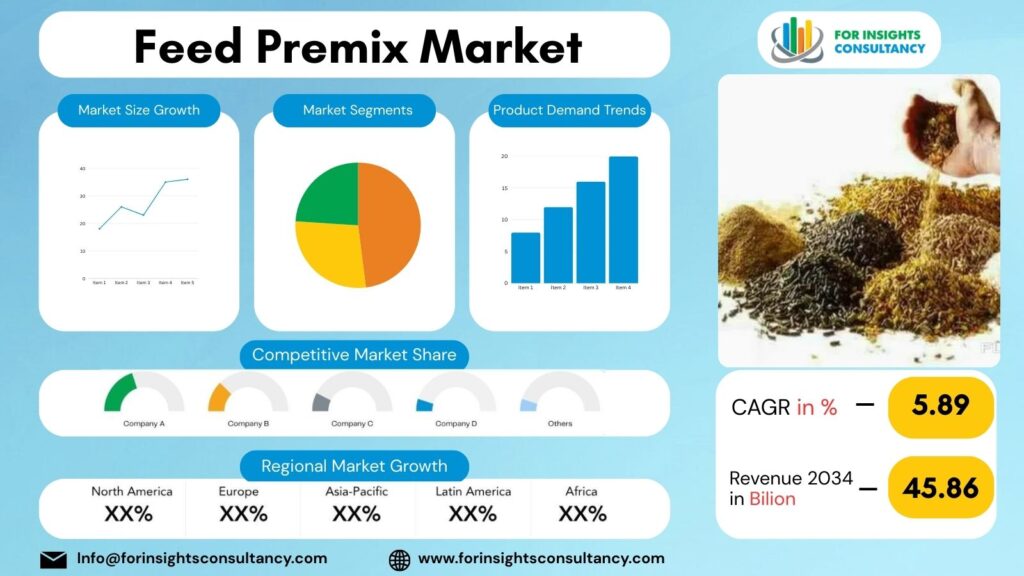
The Global Feed Premix Market is projected to be prized at USD 31.4 Billion in 2025 and is expected to reach USD 45.86 Billion by 2034, growing at a compound annual growth rate (CAGR) of 5.89% from 2026 to 2034.
Feed Premix Market: Overview and Growth in the Upcoming Year
It is anticipated that by 2026, indications signal that the Feed Premix Market will grow steadily and sustainably owing to the needs that come with modern animal production which are growing, along with the increasing focus on an balanced diet for animals. Feed premixes are mixtures of vitamins, minerals, amino acids and functional additives manufactured according to predetermined combinations (formulations). They enhance the health of animals, improves productivity and ensure uniform quality of feed under commercial farm conditions.
By 2026, there is increasing adoption of scientifically formulated nutrition programs by livestock producers to optimize production efficiency while meeting worldwide demand for meat, dairy and aquaculture products. With the intensification of farming systems, the importance of premixes as a helpful solution for accurate nutrient intake and deficiency reduction has increased. The trend indicates a shift from traditional feeding practices toward data-driven and performance-oriented animal nutrition methods.
The market is also being driven by higher awareness about animal welfare and feed efficiency. Farmers and feed producers are focusing on formulations that boost immunity, enhance digestion and improve overall livestock resilience in the face of climate change and diseases. Premix solutions that are customized according to species, age groups, and production objectives have become common. This helps producers improve output quality while controlling operating costs.
According to the report, technological development within the feed industry is another factor which will shape the market development in 2026. More effective and consistent premix products are being manufactured as a great quality ingredient formulation, stability and combination of additives. Feed producers are able to improve nutrient absorption and reduce feed waste with these advancements which make them more economically and environmentally viable.
The market growth in the region will increase due to a rise in commercial livestock farming in developing economies along with continuous innovations in the established agricultural markets. The increasing consumption of inputs by the growing urban population and modernization of feed production infrastructure is intensifying the demand for premix across the world.
The analysis of the feed premix market shows that the industry is well-balanced between nutrition, operation and sustainability goals.
global agriculture sector focussing on producing more with even lesser resources, it is expected that feed premixes are set to remain an important aspect of next-generation animal nutrition systems, and that Asia Pacific will continue to witness stable long-term growth.
Market Dynamics
Growth Drivers
Increasing Worldwide Need for Animal Protein.
The global expansion of livestock and aquaculture farming is being driven by increasing meat and dairy. As producers are urged to do their part and produce better quality output at optimum efficiency, the availability of nutrient-optimized feed premixes for quicker growth and better feed conversion ratio is a welcomed addition to their bombay.
Move Towards Accuracy Animal Nutrition
Farming is shifting from feed to precision nutrition in modern farming practises. By using feed premixes, producers can accurately formulate premix feed with the desired nutrient combinations by species, growth phase and production objective. It is also a great tool for minimizing nutrient waste while maximizing the productivity of the entire farm.
Broadening Out of Business and Integrated Farming
Due to the expansion of large commercial farms and vertically integrated livestock production systems in 2026, the growing demand for standardized, science-based feed solution leads to increased reliance on premixes to deliver consistent animal performance across large herds or flocks.
Increased Attention to Animal Health and Immunity
Producers have prioritized disease prevention and livestock resilience more than ever. Diets fortified with vitamins, minerals, and functional additives can aid in enhancing the immune system and preventing health issues in intensive production systems.
Optimizing Costs and Increasing Feed Efficiency.
Feed is among the most expensive operational costs in animal production. All premixes allow improved absorption and utilization of nutrients so that producers can achieve better productivity with an optimized quantity of feed. Moreover, they help in managing costs and improving profitability as well.
Industry Trends
A Move Towards More Precision Nutrition Solutions.
The adoption of precision nutrition is one of the major market trends which is rising. Maker of feeds are making premixes for particular species, growth stages and production situations. By improving nutrient utilization, reducing feed waste and enhancing livestock performance this feed is best.
Demand for functional and specialty premixes is increasing.
Manufacturers are moving toward functional premixes that encourage immunity and digestive health, as well as stress management and other qualities. More and more formulations include additives such as probiotics, enzymes and antioxidants to enhance resilience and productivity in animals.
Decrease Need of Antibiotics.
The sector is moving to other dietary alternatives that help support animal health without the routine use of antibiotics. Natural performance enhancers and gut-health premix formulations are becoming increasingly popular with producers adapting to changing regulations and consumer trends.
Customized Feed Formulation Growth
The year 2026 will see the rise of customization as a competitive differentiator, as feed companies work closely with farms to design premixes from locally-available feed materials specific to climate and production targets. There will be long-term strategic partnership between premix suppliers and livestock producers.
Digital and Data-Driven Formulation Integration
The use of digital and analytical tools in feed formulation. Advanced modeling systems optimize nutrient ratios and predict animal performance outcomes. They can improve formulation accuracy for premix manufacturers which can deliver a much more consistent and efficient solution.
Restraints
The prices of raw materials keep on changing.
A reliance on micronutrients, including vitamins, minerals, and various amino acids, is found in feed premixes, some of which are sensitive supply chains. The production costs for manufacturers will increase due to price volatility in these ingredients. Additionally, feed producers will face price challenges in cost-sensitive markets.
Small Farmers with High Cost Sensitivity
Although premixes increase productivity over the long run, the initial costs deter small and medium farmers. In emerging agricultural economies, producers often place greater importance on lower upfront feed costs than on nutritional formulations, limiting market access.
Complicated Legal Constraints.
Animal nutrition products are regulated for safety and quality by various countries. Varied compliance requirements for regional standards for feed additives, labeling, and ingredient approvals can delay product launches and lead to operational complexity for global players.
Traditional farming systems have limited information.
In some areas, traditional feeding practices are employed, with awareness of scientifically balanced feeding still developing. The absence of technical knowledge with respect to the benefits of premix affects the adoption of premix especially by independent farmers that depend upon traditional methods of feed preparation.
Difficulties with the Supply Chain and Storage
Handling and storage conditions of premixes should be controlled to maintain stability. When logistical infrastructure is underdeveloped, keeping the product in good shape during transport and storage poses an operational constraint.
Challenges
Nutritional consistency across diverse production conditions.
Globally, the climate and scale of livestock production varies greatly. Premix formulations that perform consistently in all feed materials and production systems represent a continuing technical hurdle for the manufacturer.
Rising Need for Personalization.
Although customized premixes provide great opportunities for growth, they also add complexity to formulations and production costs. Manufacturers need to bring in technical knowledge and accurate formulations along with flexible production capabilities to meet individual needs of customers without losing efficiency.
Navigating changing regulatory frameworks
There are big differences in standards and approvals for feed additives across countries. Businesses expanding internationally will frequently be required to change formulations and labeling practices which delays market entry and adds to the burden of compliance management.
Crafting Economical Production and Product Innovation
To achieve innovation in functional additives, enhancement of bioavailability, and advanced nutritional solutions, significant investment in research and development is required. It is a challenge to offer competitive price and fund innovation, particularly in agricultural markets.
Supply chain stability and ingredient availability
The sourcing of nutrients from locations around the world causes logistical interruptions. As demand increases, it is becoming increasingly important to ensure an uninterrupted supply while maintaining quality and delivery schedule.
Top Companies Covered In This Report
- Cargill, Inc.
- ADM
- DLG
- ForFramers
- Danish Agro
- BASF SE
- Land O’Lakes Inc.
- Godrej Agrovet Limited
- dsm-firmenich
- InVivo Group
Feed Premix Industry News
Cargill, Inc.
News (2025–2026): Expanded its vitamin and fortified premix portfolio focused on improved animal health and growth performance in 2025.
Launched a new premix production line in Mindanao to increase regional supply capacity.
Industry impact:
Cargill’s expansion improved regional supply resilience and accelerated adoption of performance-focused premixes, especially in poultry and emerging livestock markets.
ADM (Archer Daniels Midland)
News (2025–2026):
Formed a North American joint venture with Alltech to enhance additive-rich feed and nutritional solutions.
Industry impact:
The partnership strengthened ADM’s innovation ecosystem, supporting advanced feed formulations and increasing competition in functional premix solutions.
DLG Group
News (2025–2026):
Continued expansion of cooperative-led feed optimization programs across European livestock networks (industry expansion trend).
Industry impact:
DLG’s cooperative model supports farmer adoption of standardized premix nutrition, improving feed efficiency at the farm level.
ForFarmers
News (2025–2026):
Focused on sustainable feed strategies and precision livestock nutrition programs across Europe.
The company’s sustainability-driven formulations are encouraging reduced nutrient waste and environmentally optimized feed practices.
Danish Agro
News (2025–2026):
Strengthened integrated feed supply chains and digital advisory services for livestock producers.
Industry Impact:
Integration of advisory services with premix supply improves customer retention and promotes data-driven feeding decisions.
Detailed Segmentation and Classification of the report (Market Size and Forecast – 2034, Y-o-Y growth rate, and CAGR):
Segment By Type
- Vitamins Premix
- Minerals Premix
- Amino Acids Premix
- Antibiotic Premix
- Antioxidant Premix
- Customized Premix
Segment by Ingredient Type
- Vitamins
- Minerals
- Amino Acids
- Enzymes
- Probiotics
- Prebiotics
- Antioxidants
- Trace Elements
Segment by Livestock
- Poultry
- Ruminants
- Swine
- Aquaculture
- Pets
- Others
Segment by Form
- Powder
- Granules
- Liquid
Segment by Function
- Growth Promotion
- Immunity Enhancement
- Feed Efficiency Improvement
- Disease Prevention
- Reproductive Health Support
- Nutritional Balance
Segment by Distribution Channel
- Direct Sales
- Distributors & Wholesalers
- Agricultural Cooperatives
- Online Channels
Regional Deep-dive Analysis:
The report provides in-depth qualitative and quantitative data on the Feed Premix Market for all of the regions and countries listed below:
North America
The livestock and poultry industries in North America are largely industrialized. Feed companies in the region support integrated poultry, dairy, and swine production systems that require consistent and scientifically balanced feed solutions. Nutrient delivery, regulatory compliance, and animal performance predictability heavily depend upon the central role played by premixes. The heavy concentration of commercial feed mills and vertically integrated producers leads to substantial and consistent demand for premix formulations.
America.
The United States continues to lead in regional demand thanks to extensive poultry, cattle and swine production networks. With large volumes of feed to be produced and strict checks influencing the market, there is a stimulating the increased use of good quality premixes. The idea is to ensure nutrient consistency and to create and maintain product safety. The commercial feed mills in the country require premix blends for different categories of livestock on a continuous basis.
Canada.
Canada’s market growth directly relates to cultivating sustainability and efficiency in livestock practices. Premixes that enhance nutrient use while minimising negative impacts on the environment are gaining traction among producers, especially in dairy and cattle production systems that operate in more temperate climatic conditions.
Mexico.
Mexico is a growing market in North America that is exhibiting strong performance due to its growing poultry production and modernization of farming practices. The increasing demand for premixes is attributable to the rising investment commercial livestock facilities which enhance feed conversion and overall animal health performance.
Europe
Europe has a mature feed ecosystem. Thousands of premix and additive producers operate in EU and non-EU countries. The region has been responsible for a considerable share of global premix innovation, with numerous products launched over the years focusing on nutrient efficiency and animal welfare. There is a Strong Regulatory Harmonization across the European markets that fosters standardization of formulations and quality production practices which builds confidence in the premix-based feeding systems.
Germany – holds regional market dominance.
Germany remains the leader in the European feed premix industry in terms of feed infrastructure and location of significant ingredient suppliers. The strong research capabilities and sustainability policies are encouraging the adoption of specially designed premixes which also include formulations to reduce livestock emissions and improve the nutrient utilization efficiency.
Innovation Hubs – France and the Netherlands.
The diversified livestock production seen in France, along with the strong order of dairy and poultry sector, provides greater chances of success. Further, the Netherlands also benefits from the development of precision agriculture and feed formulation technologies. These countries have science-based nutritional strategies oriented toward environmental targets and animal welfare standards.
Market of Spain – Growing Very Fast
Balanced growth momentum in swine and poultry farming operations is enhancing Spain’s productivity. Farms that are bigger and more equipped with modern technology are looking for customized premix solutions for their automated feeding systems.
Eastern Europe – An Opportunity.
Eastern European countries are experiencing increasing livestock output and modernization, which is creating incremental opportunities for amino acids and enzymes such as new enzyme-based and other premixes that improve productivity and feed efficiency in animals.
Asia-Pacific
The Asia-Pacific segment holds the highest market share owing to the presence of livestock and a well-established feed production ecosystem. With 40% of global compound feed being produced in countries such as China, India, Indonesia, Thailand, Vietnam etc., demand for premixes continue to create on-going opportunity for french feed premix producers.
China – A Central Growth Hub
China is still the biggest contributor to the production of the world in global production. The government initiatives for efficient use of resources and sustainable farming are accelerating the adoption of advanced premix formulations to enhance productivity, lessen the feed waste.
India is a fast-emerging market.
In India, poultry and dairy industries are growing and bringing in new demand for vitamin and mineral premixes. Growing commercialization of farms and rising awareness of balanced animal nutrition are compelling manufacturers to offer standardized feed solutions.
Southeast Asia is a high growth corridor.
Vietnam, Indonesia and Thailand are increasingly modernising their livestock and consolidating farms. Essential requirement of performance-enhancing premixes and functional additives on account of increasing contract farming models and export-orientation of meat production.
Developed Asia Pacific Markets.
Enzyme-Based and Sustainability-Focused Premix Formulations Supported by Advanced Livestock Management and Biotechnology Innovation Hubs for Better Nutrient Efficiency and Less Environmental Impact.
Middle East and Africa
In 2026, MEA feed premix market is considered emerging to become a strategically vital growth region for the global animal nutrition sector. MEA is witnessing persistent growth on the back of growing protein consumption, modernization of livestock farming, and rising awareness towards balanced animal nutrition despite being smaller than North America and Asia-Pacific in market size.
From traditional feed to feed premix, governments and private livestock producers in the region are trying to enhance their productivity, health of the animals and profit of the farm. The structural transformation is progressively altering feed premixes from optional additives into necessary production inputs.
Arabian Gulf Cooperation Board.
The GCC countries require advanced technologies for livestock production and the use of high-quality premixes which often involve imports. More and more large poultry integrators are adopting precision nutrition and customized formulations.
Arabian Maghreb.
Egypt and Morocco are strong consumption hubs, with established poultry and dairy industries. Cost-effective premix solutions dominate purchase decisions.
Sub-Saharan Africa
As livestock populations grow, and development programs are undertaken to improve farmer productivity, growth takes place. Nonetheless, the uptake is not the same everywhere.
Frequently Asked Questions with Answers
What is the Feed Premix market size and growth forecast?
Feed Premix Market is projected to reach a value of USD 31.4 Billion in 2025 and is anticipated to grow to approximately USD 45.86 billion by 2034. This expansion reflects a compound annual growth rate (CAGR) of 5.89% during the forecast period from 2026 to 2034.
Who are the key players in the Feed Premix market?
The Feed Premix Market Includes Major Companies Nestlé S.A., PepsiCo Inc., Unilever PLC, The Coca-Cola Company, Starbucks Corporation, Keurig Dr. Pepper, The Republic of Tea, Suntory Beverage & Food, Monster Beverage Company, Dunkin Brands, Ajinomoto General Foods Inc., Others.
What are the current and future trends for Feed Premix market?
The Feed Premix market is presently gaining traction due to the increasing adoption of precision nutrition, customized premixes, sustainable feed solutions, and digitalized livestock management systems. Meanwhile, in the upcoming years, the focus is likely to shift to antibiotic-free formulations, functional additives, and data-driven smart feeding technologies.
Which regions dominate the Feed Premix market?
Asia-Pacific dominates the Feed Premix market due to its large livestock population, expanding commercial farming, and increasing demand for high-quality animal nutrition.
Key insights provided by the report that could help you take critical strategic decisions?
- Regional reports analyse product/service consumption and market factors in each region.
- Reports highlight possibilities and dangers for suppliers in the Feed Premix Market business globally.
- The report identifies regions and sectors with the highest growth potential.
- It provides a competitive market ranking of major companies, as well as information on new product launches, partnerships, business expansions, and acquisitions.
- The report includes a comprehensive corporate profile with company overviews, insights, product benchmarks, and SWOT analysis for key market participants.
Customization: We can provide following things
1) On request more company profiles (competitors)
2) Data about particular country or region
3) We will incorporate the same with no additional cost (Post conducting feasibility).
Any Requirement Contact us: https://www.forinsightsconsultancy.com/contact-us/
Table of Contents
For TOC Contact us: https://forinsightsconsultancy.com/contact-us/
Select PDF License
Single User: $3499
Multiple Users: $4499
Corporate Users: $5499
Buy Now!
Request Sample